mapping the best freight lanes in usa: Finding your trucking safe zones
When it comes to mapping the best freight lanes in usa, owner operators need to know their trucking safe zones. Properly mapping the best freight lanes in usa ensures you reduce deadhead miles, avoid languishing zones, and protect weekly carrier revenue.
When it comes to mapping the best freight lanes in usa, owner operators need to know their trucking safe zones. Properly mapping the best freight lanes in usa ensures you reduce deadhead miles, avoid languishing zones, and protect weekly carrier revenue.
When it comes to mapping the best freight lanes in usa, owner operators need to know their trucking safe zones. Properly mapping the best freight lanes in usa ensures you reduce deadhead miles, avoid languishing zones, and protect weekly carrier revenue.
When it comes to mapping the best freight lanes in usa, owner operators need to know their trucking safe zones. Properly mapping the best freight lanes in usa ensures you reduce deadhead miles, avoid languishing zones, and protect weekly carrier revenue.
When it comes to mapping the best freight lanes in usa, owner operators need to know their trucking safe zones. Properly mapping the best freight lanes in usa ensures you reduce deadhead miles, avoid languishing zones, and protect weekly carrier revenue.
When it comes to mapping the best freight lanes in usa, owner operators need to know their trucking safe zones. Properly mapping the best freight lanes in usa ensures you reduce deadhead miles, avoid languishing zones, and protect weekly carrier revenue.
When it comes to mapping the best freight lanes in usa, owner operators need to know their trucking safe zones. Properly mapping the best freight lanes in usa ensures you reduce deadhead miles, avoid languishing zones, and protect weekly carrier revenue.
When it comes to mapping the best freight lanes in usa, owner operators need to know their trucking safe zones. Properly mapping the best freight lanes in usa ensures you reduce deadhead miles, avoid languishing zones, and protect weekly carrier revenue.
Best Freight Lanes in the USA: Find Your Trucking Safe Zones
Every owner-operator and fleet owner knows the feeling.
You accept a great-paying load. The rate looks strong. The truck moves. The delivery gets done.
Then the problem starts.
You realize the truck has landed in a region with very little outbound freight. The load paid well on the way in, but now you are facing hours of waiting, weak reload options, or hundreds of deadhead miles just to find the next haul.
At Skylink USA, we call these dead-end freight areas languishing zones.
They are the places where a carrier may get paid to enter, but then struggle to get out profitably.
The smarter goal is to plan your week so the truck keeps operating in the green.
Welcome to the trucking Safe Zone strategy.
This guide explains how owner-operators can identify the best freight lanes in the USA, avoid languishing zones, reduce deadhead, and use a professional truck dispatch service to keep freight movement more profitable.
Why One High-Paying Load Can Still Create a Weak Week
A high-paying load is not always a profitable load.
That sounds strange, but every serious carrier learns it sooner or later.
A load can pay a strong rate per mile and still damage the week if it sends the truck into a weak outbound market. The carrier may end up sitting too long, accepting cheap freight, or driving unpaid miles to reach a better market.
That is why the best freight lanes in the USA should not be judged by one rate only.
A better lane decision looks at:
- Rate per mile
- Total miles
- Deadhead before pickup
- Deadhead after delivery
- Reload strength
- Fuel cost
- Broker reliability
- Equipment fit
- Seasonal freight movement
- Weekly route flow
A good dispatcher is not just trying to book the next load.
A good dispatcher is trying to protect the whole week.
Micro Scenario: The Great Load That Turned Into a Languishing Zone
A dry van carrier accepts a strong load into a small market because the rate looks attractive.
The load pays well.
But after delivery, there are only a few outbound loads available. The truck waits most of the day. The next decent load requires 175 deadhead miles.
By the time fuel, time, and empty miles are counted, the original high-paying load does not look as strong anymore.
That is a languishing zone problem.
The better move may have been a slightly lower-paying load that delivered into a stronger freight market with more reload options.
What Skylink Calls a Trucking Safe Zone
A Safe Zone is not one magical city where every load pays well.
A Safe Zone is a broader freight corridor where the freight-to-truck ratio is more favorable for the carrier.
In simple words, it is an area where the truck has better options after delivery.
Operating inside a Safe Zone usually means:
- Consistent outbound volume
- Better reload options within a practical radius
- More broker activity
- Stronger freight movement
- Better rate stability
- Less pressure to accept cheap freight
- Lower deadhead risk
The best freight lanes are not always the highest-paying lanes on one load board search.
The best lanes are the lanes that help the truck keep earning after delivery.
This is why Safe Zones matter.
They help owner-operators think beyond one load and plan the full movement of the truck.
The Safe Zone Strategy: Outbound Volume, Rate Stability, and Triangle Routes
A strong Safe Zone strategy has three main parts.
1. Consistent Outbound Volume
A good freight lane should leave the truck near multiple reload options.
The original idea is simple:
After delivery, the carrier should have several practical load options within a reasonable radius.
This does not mean every load will be perfect. It means the carrier is less likely to get trapped.
2. Rate Stability
Spot market rates change.
But some freight corridors hold a stronger baseline because shipper demand is consistent and trucks are needed regularly.
This creates better rate stability.
A Safe Zone should give the carrier a better chance of finding freight that supports the week, not just one move.
3. The Triangle Strategy
The Triangle Strategy is one of the strongest ideas in the original blog.
Instead of running only back-and-forth lanes, a carrier can plan a triangle route.
Example:
- Point A to Point B
- Point B to Point C
- Point C back toward Point A
This approach can reduce empty miles and keep the truck moving through stronger markets.
A dispatcher can use this strategy to plan weekly movement instead of reacting to loads one at a time.
Pro Tip 1: Always Check the Market After Delivery
Before accepting a load, ask one question:
What happens after delivery?
If the destination has weak outbound freight, the rate should be strong enough to justify that risk.
If it is not, the load may not be worth it.
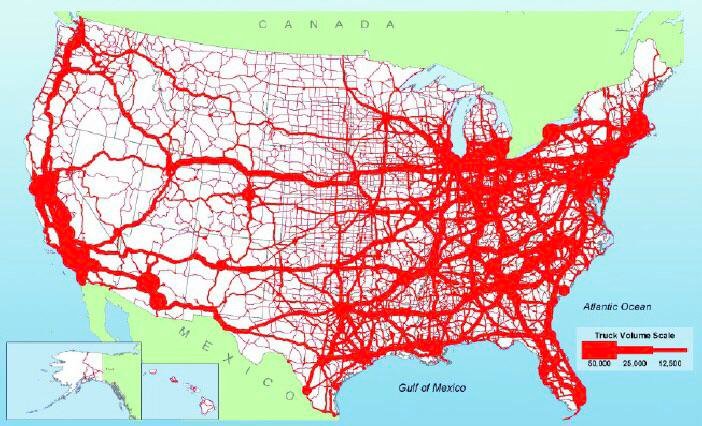
Historical Map of Best Freight Lanes by Truck Type
Important publishing note:
These are historical lane examples and planning references. Live rates change daily based on market conditions, season, equipment, fuel cost, and capacity. Do not present any lane rate as a guaranteed current rate unless it is verified at the time of publishing.
Carriers and dispatchers can use tools such as DAT Trendlines to monitor freight market movement and spot market conditions.
| Truck Type | Historical Lane Examples | Why These Lanes Matter |
|---|---|---|
| Dry Van | Southern California (LAX/ONT) to Midwest/East Coast. Laredo, TX to Chicago, IL. South Florida to Northeast. Atlanta, GA to New York, NY. | These lanes can connect major freight markets, industrial demand, cross-border freight, and high-volume distribution areas. |
| Reefer | Plant City, FL to New York, NY during produce season. Fresno, CA to Boston, MA. Immokalee, FL to Boston, MA. Midwest protein lanes from Iowa/Nebraska to East Coast. | Reefer lanes often shift with produce, food distribution, temperature-sensitive freight, and seasonal demand. |
| Flatbed | Gary, IN/Chicago, IL steel markets. Birmingham, AL/Atlanta, GA construction/steel freight. Houston/Dallas oilfield pipes and data center materials. Pennsylvania to Southeast construction materials. | Flatbed lanes depend heavily on industrial freight, steel, construction, equipment, and project-based movement. |
| Conestoga | Steel, machinery, and protected freight lanes in industrial regions such as Midwest, Pennsylvania, Southeast, and Texas markets. | Conestoga trailers can be valuable where freight needs protection without standard tarping delays. |
| Hotshot | Texas Triangle (Dallas, Houston, San Antonio). Laredo, TX to Midwest. Midwest regional machinery and automotive parts. | Hotshot lanes often depend on urgent, time-sensitive, industrial, and short-haul freight. |
| Box Truck | Regional runs in Texas, Florida, and Georgia. Ohio and Illinois industrial replenishment. Major metro-to-metro lanes such as Atlanta to Charlotte. | Box truck lanes often work best with local, regional, and metro-to-metro freight density. |
Dry Van Safe Zones
Dry van freight often performs well around major distribution markets.
The original blog mentioned several dry van lane examples:
- Southern California, including LAX and Ontario, to the Midwest or East Coast
- Laredo, TX to Chicago, IL
- South Florida to the Northeast
- Atlanta, GA to New York, NY
- Chicago to Atlanta and back
These examples make sense as planning references because they connect large freight markets, border freight, retail distribution, and industrial movement.
A dry van dispatch service should not only search for posted loads. It should check whether the lane creates a clean reload path after delivery.
For dry van carriers, the lane must support movement after the drop.
That is the real Safe Zone test.
Reefer Safe Zones
Reefer lanes can change quickly because refrigerated freight depends on food movement, produce seasons, appointment windows, and temperature-sensitive supply chains.
The original blog mentioned reefer lane examples such as:
- Plant City, FL to New York, NY during produce season
- Fresno, CA to Boston, MA
- Immokalee, FL to Boston, MA
- Midwest protein lanes from Iowa or Nebraska to the East Coast
These are useful examples because reefer carriers often follow seasonal and regional demand patterns.
A reefer dispatch service should consider more than the rate.
It should also check:
- Temperature requirements
- Appointment windows
- Detention risk
- Food-grade requirements
- Delivery market strength
- Reload options
- Seasonal movement
Reefer freight can pay well, but poor planning can still create delays and weak reloads.
Flatbed and Conestoga Safe Zones
Flatbed and conestoga carriers need equipment-specific lane planning.
The original blog mentioned strong flatbed and conestoga areas such as:
- Gary, IN and Chicago, IL for steel
- Birmingham, AL and Atlanta, GA for construction and steel freight
- Houston and Dallas for oilfield pipes and data center materials
- Pennsylvania to Southeast construction material movement
- Industrial machinery and protected freight for conestoga trailers
These examples are important because flatbed and conestoga freight often depends on industrial activity, construction, steel, machinery, and project-based demand.
A flatbed dispatch service should consider tarping, securement, loading time, weight, and equipment requirements.
A conestoga dispatch service should focus on freight that needs protection, cleaner handling, and stronger equipment fit.
The original blog also mentioned that data center projects can drive high-paying heavy haul opportunities.
That idea should stay, but it should be worded carefully.
Project-based freight can create strong opportunities, but live rates should always be verified before publishing exact rate claims.
Hotshot Safe Zones
Hotshot carriers need tight lane planning because wasted miles can quickly reduce profit.
The original blog mentioned hotshot lanes such as:
- Texas Triangle: Dallas, Houston, and San Antonio
- Laredo, TX to Midwest
- Midwest regional machinery parts and automotive freight
- Texas, Oklahoma, and Midwest short-haul industrial freight
These are useful examples because hotshot freight often depends on urgent movement, industrial customers, cross-border freight, and regional timing.
A hotshot dispatch service should protect:
- Mileage
- Time
- Weight limits
- Load fit
- Delivery urgency
- Fuel cost
- Reload options
Hotshot carriers cannot afford to chase random freight into weak areas.
The best lanes are the ones that protect time and keep the truck positioned near practical freight.
Box Truck Safe Zones
Box truck carriers usually need a different strategy from semi-truck carriers.
The original blog mentioned box truck lane examples such as:
- Regional runs in Texas, Florida, and Georgia
- Ohio and Illinois industrial replenishment
- Major metro-to-metro routes such as Atlanta to Charlotte
- Southeast and Texas short-haul manufactured goods
These examples should stay because they match the way many box truck carriers operate.
A box truck dispatch service should focus on:
- Local freight density
- Regional delivery opportunities
- Metro-to-metro movement
- Practical pickup and delivery timing
- Avoiding low-paying or time-wasting loads
- Reducing empty mileage
Box truck carriers should be especially careful with lanes that look active but waste too much time between pickup and delivery.
Best Freight Lane Trends to Watch in 2026
Important lane trends to watch include:
Midwest Core
Chicago, Indianapolis, Columbus, and nearby industrial markets can create consistent freight movement for several equipment types.
Southeast and Gulf Coast
Atlanta, Dallas, Houston, and Memphis can work as major freight hubs because of distribution, industrial movement, port access, and regional freight density.
Regional 300 to 500 Mile Runs
The original blog correctly mentioned that focusing on a 300 to 500 mile radius can sometimes produce better pay per mile than crossing multiple time zones.
This can be especially useful for:
- Box trucks
- Hotshots
- Regional dry vans
- Flatbeds in industrial corridors
Seasonal Movement
Safe Zones shift throughout the year.
Produce season, retail cycles, construction activity, weather, fuel cost, and capacity changes can all move freight demand.
For a broader government data view, the Bureau of Transportation Statistics maintains freight transportation resources.
Areas to Be Careful With: Avoiding Languishing Zones
The original blog warned about bad areas, and that point should stay.
A bad area is not always bad forever. Some markets are strong in one season and weak in another.
But carriers should be careful with areas that have low outbound volume.
The original blog mentioned examples such as Florida, parts of California, and some areas in the Pacific Northwest depending on the season.
This should be worded carefully because those markets can change.
Better wording:
Some areas can become difficult to leave depending on season, equipment type, and outbound freight demand. A load into these areas may still be worth taking, but the rate should cover the risk.
Before entering a possible languishing zone, the dispatcher should check:
- Outbound load volume
- Nearby reload markets
- Deadhead distance
- Fuel price pressure
- Time of year
- Equipment fit
- Broker reliability
- Rate strength
Diesel price movement also matters. Carriers can monitor fuel updates through the U.S. Energy Information Administration’s Gasoline and Diesel Fuel Update.
Did You Know 2: Fuel Can Turn a Good Lane Into a Weak Lane
A lane can look profitable until fuel and empty miles are counted.
When diesel prices rise, deadhead becomes more expensive.
That means freight lane planning should always consider fuel cost, not only posted rate.
How Data Tools and Broker Relationships Help
The original blog had another strong idea:
Do not rely only on the spot market.
That is correct.
Owner-operators can improve lane consistency by building broker relationships and looking for recurring freight patterns.
A dispatcher can use market tools and broker communication to find:
- Recurring freight
- Stronger lanes
- Dedicated or semi-dedicated opportunities
- Brokers with repeat loads
- Better weekly patterns
- Lanes that match the carrier’s equipment
Dedicated freight is not always formal.
Sometimes it starts with consistency.
If a carrier performs well for the same broker on the same lane, that relationship can lead to repeated opportunities.
Pro Tip 2: Build Relationships Around Strong Lanes
Do not only chase one-time loads.
When a lane works well, track the broker, commodity, pickup area, delivery market, rate range, and reload options.
Over time, this helps the dispatcher find repeat lanes and more predictable weekly movement.
How Skylink Helps Carriers Stay in the Safe Zone
A good dispatcher is not just a booking agent.
A good dispatcher is a route planner.
Skylink Logistics helps owner-operators and small fleets think beyond one load at a time.
The goal is to keep carriers in stronger freight zones, reduce deadhead, support better rate negotiation, and handle the paperwork that slows drivers down.
Skylink’s dispatch process should help with:
- Load searching
- Freight lane planning
- Safe Zone strategy
- Deadhead reduction
- Broker communication
- Rate negotiation
- Equipment-specific dispatch
- Paperwork support
- Carrier setup
- Factoring coordination
- Weekly route planning
Carriers can review the truck dispatch pricing page before starting.
If cash flow and payment speed are part of the challenge, carriers can also review Skylink’s factoring setup page.
To get started, use the carrier setup portal or contact Skylink Logistics.
Let Skylink Help Plan Your Next Freight Move
You focus on driving safely. Let Skylink focus on keeping you in the Safe Zone.
The dispatch team analyzes freight opportunities, lane direction, broker communication, and truck movement so carriers can avoid getting stranded in weak markets.
Skylink helps map the strategy, support rate negotiation, and organize paperwork so owner-operators can spend more time on the road and less time chasing uncertain freight.
Ready to reduce deadhead and start planning better routes?
Start through the carrier setup portal or speak with the team through the contact Skylink Logistics page.
Final Word
The best freight lanes in the USA are not only the highest-paying lanes.
They are the lanes that help a truck keep moving profitably after delivery.
That is the real Safe Zone strategy.
A strong lane should support outbound volume, rate stability, reload options, equipment fit, and weekly movement.
A weak lane may pay well once but create deadhead, downtime, and pressure to accept cheap freight.
With better lane planning, data awareness, broker relationships, and the right dispatch support, owner-operators can avoid languishing zones and build stronger weeks.
Skylink USA can help carriers plan better routes, reduce empty miles, and stay closer to profitable freight movement.
Email: dispatch@skylinkusa.com | Phone: (346) 214-5292 | Office: 700 Smith Street #61070 SMB, Houston, TX 77002
Hours: Monday to Friday, 8:00 AM to 5:00 PM
Frequently Asked Questions
Find answers to the most common questions about freight lanes and Safe Zones
What are the best freight lanes in the USA?
The best freight lanes are routes with strong freight volume, fair rates, good reload options, and lower deadhead risk. The best lane also depends on truck type, season, and destination market strength.
What is a trucking Safe Zone?
A trucking Safe Zone is a freight corridor where the carrier has better outbound options after delivery. It usually has stronger freight volume, better reload potential, and less risk of getting stuck.
What is a languishing zone in trucking?
A languishing zone is a weak freight area where a truck may deliver a load but then struggle to find a profitable next load. These areas can create downtime, deadhead, and pressure to accept low-paying freight.
What is the Triangle Strategy in trucking?
The Triangle Strategy means planning routes from Point A to Point B, then Point B to Point C, and then back toward Point A. This can reduce empty miles compared with simple back-and-forth movement.
Which freight lanes are good for dry van carriers?
Dry van carriers often look for lanes connected to major distribution and industrial markets, such as Southern California to Midwest or East Coast, Laredo to Chicago, South Florida to Northeast, and Atlanta to New York.
Which freight lanes are good for reefer carriers?
Reefer lanes often follow produce, food, and temperature-sensitive freight. Examples include Florida produce lanes to the Northeast, California produce lanes to the East Coast, and Midwest protein lanes.
Which freight lanes are good for flatbed and conestoga carriers?
Flatbed and conestoga carriers often follow steel, construction, machinery, industrial, and protected freight lanes. Markets around Chicago, Gary, Birmingham, Atlanta, Houston, Dallas, Pennsylvania, and the Southeast can be important planning areas.
Can dispatch support help reduce deadhead?
Yes. A dispatch service can help reduce deadhead by checking destination markets, reload options, equipment fit, fuel cost, and lane direction before the carrier accepts a load.
Should owner-operators rely only on spot market loads?
No. Spot market loads can help, but owner-operators should also build broker relationships and look for recurring lanes. Consistent lanes can help create more predictable weekly movement.
Where can carriers start with Skylink?
Carriers can start through the carrier setup portal or contact the Skylink team through the contact page.
Posted by: Kiran Noor
Call: (346) 214-5292 | Email: dispatch@skylinkusa.com